
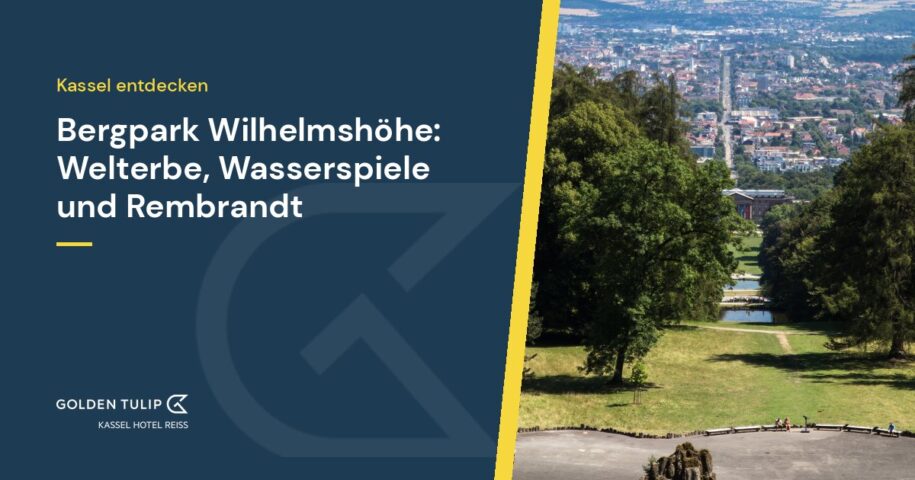
Mittwoch, kurz vor halb drei, oben am Herkules. Die Menschen stehen still, gleich setzt sich das Wasser in Bewegung, wie schon vor dreihundert Jahren.
Der Bergpark Wilhelmshöhe ist für viele unserer Gäste der eigentliche Grund für Kassel. Wir vom Golden Tulip Kassel Hotel Reiss hören das immer wieder. Ein Tag reicht nicht. Herkules, Wasserspiele, Gemäldegalerie – das braucht Zeit. Wer die Wasserspiele erleben will, plant am besten den ganzen Nachmittag ein. Vom Hauptbahnhof bis dorthin ist es ein Stück Weg, die Straßenbahn nimmt Ihnen die Arbeit ab.
Der erste Bergpark mit Welterbe-Titel
Am 23. Juni 2013 hat die UNESCO entschieden. Der Bergpark Wilhelmshöhe wurde Weltkulturerbe, als erster Bergpark weltweit. Mit rund 560 Hektar ist er der größte Bergpark Europas, mit Kaskaden und barocken Wasserbauten mitten im Wald.
Die Idee stammt von Landgraf Karl von Hessen-Kassel. Ab 1696 ließ er den Berg umbauen, mit Kaskaden, Grotten und der Herkules-Statue als Krönung. Was damals ein fürstliches Prestigeprojekt war, ist heute Weltkulturerbe.
Ganz oben steht die Herkules-Statue auf ihrem Oktogon. Von dort reicht der Blick über ganz Kassel, an klaren Tagen weit ins Umland. Der Aufstieg lohnt sich auch an einem ruhigen Tag ohne Wasserspiele.
Wenn der Berg das Wasser losschickt
Von Mai bis Anfang Oktober fließt das Wasser mittwochs, sonntags und an Feiertagen. Los geht es um 14:30 Uhr, direkt am Herkules. Von dort läuft es über Kaskaden, den Steinhöfer Wasserfall, die Teufelsbrücke und ein Aquädukt hinunter zum Schlossteich.
750.000 Liter Wasser auf 2,3 Kilometern. Ganz ohne Pumpen, nur durch die Schwerkraft. Das System funktioniert bis heute genauso wie zur Zeit seiner Erbauung. Man hört das Wasser oft, bevor man es sieht.
Gegen 15:45 Uhr kommt der Moment, auf den alle warten. Die Große Fontäne schießt über 50 Meter in die Höhe. Als sie 1767 entstand, war sie die höchste Fontäne der Welt. Um 16 Uhr ist das rund eineinhalbstündige Spektakel vorbei, dann wird es still am Schlossteich.
Der Eintritt in den Park und zu den Wasserspielen ist frei. Nur für Schloss und Gemäldegalerie zahlen Sie ein Ticket.
Für den Weg nach oben nehmen Sie die Straßenbahnlinie 4 bis Druseltal, von dort bringt Sie der Bus 22 oder 23 direkt zum Herkules. Wer Zeit hat, folgt dem Wasser anschließend zu Fuß den ganzen Berg hinunter, vorbei an Kaskaden und Wasserfällen bis zum Schloss.
Rembrandt wartet im Schloss
Unten am Teich liegt das Schloss Wilhelmshöhe. Darin hängt seit 1974 die Gemäldegalerie Alte Meister. Zwölf Gemälde von Rembrandt gehören zur Sammlung, darunter Jakobs Segen und ein Porträt seiner Frau Saskia. Auch Frans Hals hängt hier, mit seinem berühmten Mann mit Schlapphut.
Die Säle sind oft leer, gerade wenn draußen am Berg die Wasserspiele laufen. Trubel und Stille, im selben Park, an ein und demselben Nachmittag.
Mit der Straßenbahnlinie 1 kommen Sie bis zur Endstation Wilhelmshöhe Park. Von dort sind es nur wenige Schritte zum Schloss und zur Galerie.
Für einen Regentag ist das Schloss genau richtig. Für den Nachmittag nach den Wasserspielen aber auch.
UNESCO-Welterbe seit 23. Juni 2013, als erster Bergpark weltweit.
Größter Bergpark Europas, rund 560 Hektar, höchster Punkt die Herkules-Statue.
Wasserspiele: 1. Mai bis 3. Oktober, mittwochs, sonntags und an Feiertagen, Beginn 14:30 Uhr am Herkules, Eintritt frei.
750.000 Liter Wasser fließen über 2,3 Kilometer, ganz ohne Pumpen, allein durch Schwerkraft.
Große Fontäne gegen 15:45 Uhr, über 50 Meter hoch, gebaut 1767.
Gemäldegalerie Alte Meister im Schloss Wilhelmshöhe: zwölf Gemälde von Rembrandt, seit 1974 dort zu sehen.
Zur documenta 16, vom 12. Juni bis 19. September 2027, reicht ein Wochenende oft nicht. Der Bergpark braucht seinen eigenen Tag. Bis zum 30. November 2026 gilt unser Frühbucherpreis für die dritte Nacht.
In English
Wednesday, twenty-five past two, up at the Hercules statue. People stand still. In minutes, the water will start moving, just as it has for three hundred years.
For many of our guests, Bergpark Wilhelmshöhe is the whole reason for coming to Kassel. We hear it again and again at the Golden Tulip Kassel Hotel Reiss. One day is not enough. Hercules, the water displays, the picture gallery, all of that takes time. If you want to see the water displays, plan the entire afternoon around them. The park sits a fair way from the main station, but the tram does the walking for you.
The first mountain park with World Heritage status
On 23 June 2013, UNESCO made its decision. Bergpark Wilhelmshöhe became a World Heritage Site, the first mountain park anywhere to earn that title. At roughly 560 hectares, it is the largest mountain park in Europe, with cascades and baroque water features set into the forest.
The idea came from Landgrave Karl of Hesse-Kassel. From 1696 he had the mountain reshaped, with cascades, grottoes, and the Hercules statue as its crown. What began as a prince’s showpiece is now a World Heritage Site.
At the very top, the Hercules statue stands on its octagon. From there, the view stretches over all of Kassel, and on clear days far into the surrounding hills. The climb is worth it even on a quiet day, with no water in sight.
When the mountain lets the water go
From May to early October, the water runs on Wednesdays, Sundays, and public holidays. It starts at 2:30pm, right at the Hercules statue. From there it flows down through cascades, the Steinhöfer waterfall, the Devil’s Bridge, and an aqueduct, all the way to the palace pond.
750,000 litres of water over 2.3 kilometres. No pumps, only gravity. The system still works exactly as it did when it was built. Often you hear the water before you see it.
Around 3:45pm comes the moment everyone is waiting for. The Great Fountain shoots more than 50 metres into the air. When it was built in 1767, it was the tallest fountain in the world. By 4pm, the display is over, roughly ninety minutes after it began, and the palace pond falls quiet again.
Entry to the park and the water displays is free. You only pay for a ticket to the palace and the picture gallery.
Take tram line 4 up to Druseltal, then bus 22 or 23 straight to the Hercules statue. If you have the time, walk back down afterwards, following the water past cascades and waterfalls all the way to the palace.
Rembrandt is waiting at the palace
Down by the pond stands Wilhelmshöhe Palace. It has housed the Old Masters Picture Gallery since 1974. Twelve paintings by Rembrandt belong to the collection, among them Jacob’s Blessing and a portrait of his wife Saskia. Frans Hals hangs here too, with his well-known Man with a Slouch Hat.
The galleries are often empty, especially while the water is running outside on the mountain. Crowds and quiet, in the same park, on the very same afternoon.
Tram line 1 takes you to the last stop, Wilhelmshöhe Park. From there it is only a few steps to the palace and the gallery.
On a rainy day, the palace is exactly right. On the afternoon after the water displays, it works just as well.
UNESCO World Heritage Site since 23 June 2013, the first mountain park in the world.
Largest mountain park in Europe, around 560 hectares, its highest point the Hercules statue.
Water displays: 1 May to 3 October, Wednesdays, Sundays, and public holidays, starting 2:30pm at the Hercules statue, free entry.
750,000 litres of water flow over 2.3 kilometres, with no pumps, driven by gravity alone.
Great Fountain around 3:45pm, over 50 metres high, built in 1767.
Old Masters Picture Gallery at Wilhelmshöhe Palace: twelve paintings by Rembrandt, on view there since 1974.
For documenta 16, running 12 June to 19 September 2027, a weekend often will not be enough. The Bergpark deserves a day of its own. Until 30 November 2026, our early-booking rate applies to the third night.
Dieser Beitrag wurde mit KI-Unterstützung erstellt. Redaktionell verantwortlich: Hotel Reiss, Kassel. This article was created with AI assistance.